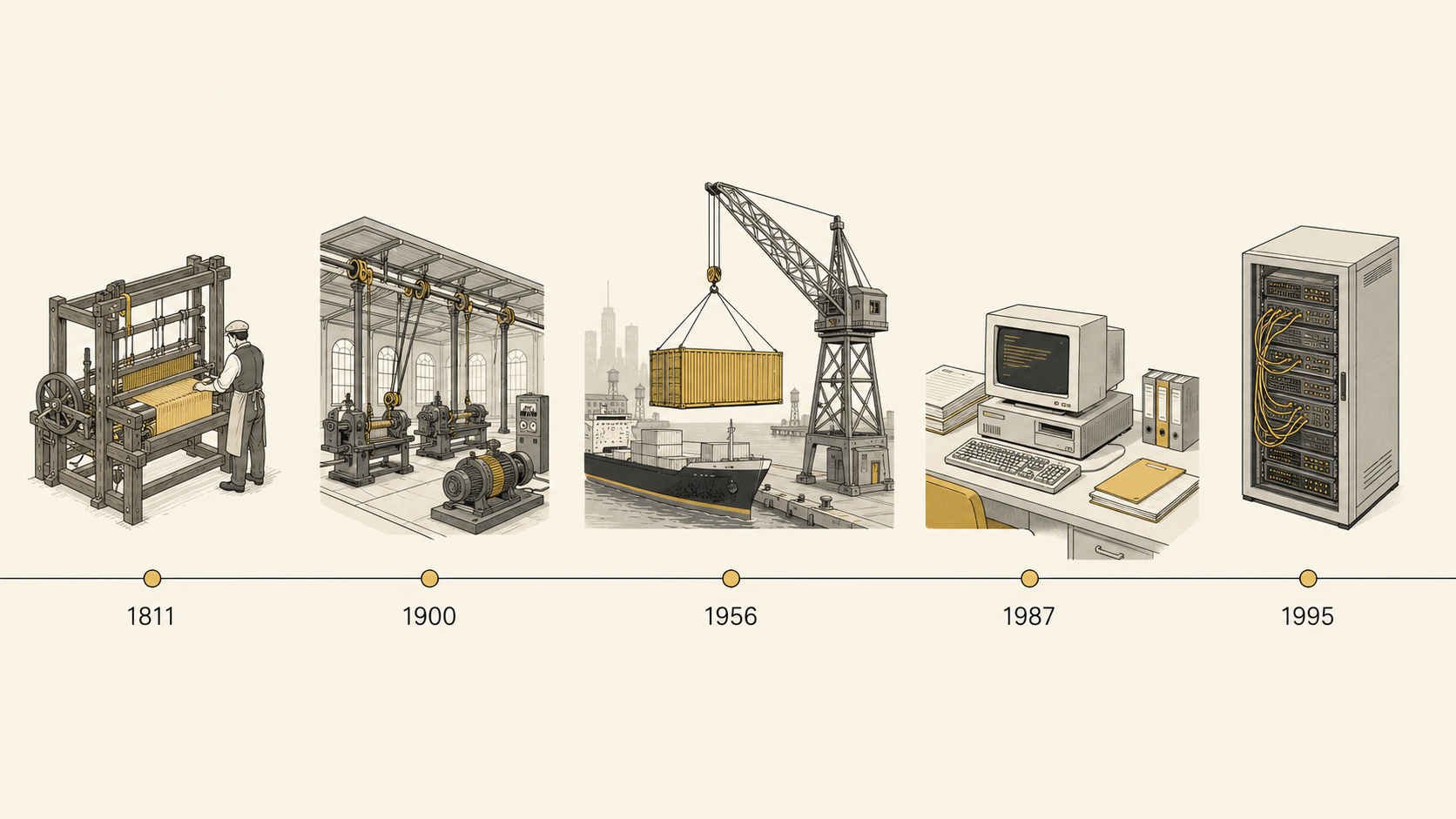
Every conversation about AI now arrives at the same two questions. Which jobs will it replace. Will it create new ones. These are reasonable questions. They are also, in their structure, identical to questions asked at five earlier moments in industrial history. The answers given then are not the answers being given now, and the difference is instructive.
This piece is not an argument for or against AI. It is a structural reading of how technology transitions actually play out, drawn from five cases where the historical record is long enough to be honest about. The pattern that emerges does not resolve the contemporary question. It does sharpen it.
1811. The Luddites had a point
The Luddites are usually invoked as shorthand for irrational opposition to progress. The historical record is less flattering to that framing. The framework knitters of Nottinghamshire, the croppers of Yorkshire, and the cotton weavers of Lancashire were skilled artisans with a coherent economic argument. They had spent years acquiring craft. They had stable wages and a recognised place in their towns. The new wide knitting frames and powered looms did not require their skills, and the manufacturers who installed them hired unapprenticed youth and women at a fraction of the wage.
Before they broke any machines, the Luddites tried negotiation. They petitioned for a minimum wage. They asked for adherence to existing labour standards. They proposed a tax to fund a pension for displaced workers. None of these requests were granted. The British government instead made machine-breaking a capital offence and deployed twelve thousand troops, more than Wellington had under his command in the Peninsular War at the same moment, to suppress the movement.
The artisans lost. Not because they were wrong about what was happening to them. They were right. Hand weavers who had earned a respectable wage in a day were soon earning the same wage in a week. The price of textiles fell sharply, and the consumer class that benefited from those prices was a different group of people than the one that paid the cost. The transition was real and the suffering was real. What the Luddites lacked was not analysis. It was political power.
The lesson worth carrying forward is not that resistance is futile. It is that resistance to a productivity differential of this magnitude has historically required a political settlement, not a technological reversal. The Luddites were defeated. The reforms they asked for, minimum wage, labour standards, worker protections, were eventually granted. It took roughly a century.
1880 to 1920. The electrification lag
The lightbulb was patented in 1880. By 1900, only three percent of American residences had electric lighting. Electric motors accounted for less than five percent of factory mechanical drive. The technology was clearly superior. Its uptake was glacially slow.
The economist Paul David, in a 1990 paper that has aged better than almost any economics paper of its era, asked the obvious question. Why did the productivity gains from electrification take forty years to appear in the statistics. His answer is one of the most useful frames in industrial economics.
Factories built in the steam era were organised around a single central power source. A steam engine in the basement turned an overhead shaft, and the shaft turned belts and pulleys that drove every machine on the floor. The machines had to be physically arranged in a line beneath the shaft. The building was a function of the power source.
When electricity arrived, the first generation of factory owners did the rational short-term thing. They removed the steam engine and put a single large electric dynamo in its place. The shaft still turned. The belts still drove. The building was unchanged. The productivity gain was small.
The transformation only came when a second generation of owners realised that electric motors could be small, distributed, and embedded in each machine. The central shaft could be removed. The building could be redesigned. Workflow could be reorganised around the logic of production rather than the logic of mechanical power transmission. That redesign took roughly forty years.
The implication is uncomfortable for anyone forecasting near-term AI productivity. The technology is not the bottleneck. The operating model is the bottleneck. A general purpose technology produces its measurable gains only after the organisations using it have been rebuilt around its logic, and that rebuilding is slow because it is institutional, not technical.
1987. The Solow paradox
Robert Solow observed in 1987 that "you can see the computer age everywhere but in the productivity statistics." Personal computers were on every desk. Productivity growth, measured at the aggregate level, was stubbornly weak. The contradiction became known as the Solow paradox, and it haunted economic policy for the better part of a decade.
The resolution, when it came, was the one Paul David had predicted by analogy with electrification. The gains arrived in the late 1990s, roughly fifteen years after the initial deployment, once organisations had been redesigned around the new technology. Email replaced internal memos. Spreadsheets replaced clerical accounting. Enterprise resource planning systems replaced filing cabinets. Each of these required the underlying business process to be rebuilt, not merely automated.
The cohort that bore the cost of that redesign was not evenly distributed. Secretarial pools, typing pools, junior bookkeepers, and large parts of middle administrative labour disappeared between 1985 and 2000. The cohort that captured the gains was a different group, smaller and more concentrated, with the skills to design and operate the new systems. Productivity at the aggregate level did rise. The benefits did not flow proportionally to the workers displaced.
This is the recurring pattern. Aggregate gains are real. Distribution is a separate question, determined by political and institutional choices, not by the technology itself.
1995 to 2010. The internet did not create jobs evenly
The internet is the most recent transition for which the dust has settled enough to see clearly. The headline economic story is unambiguous. Net job creation was positive. Entire categories of work that did not previously exist were invented. Software engineering, digital marketing, e-commerce operations, search engine optimisation, content moderation, platform management, app development. The economy absorbed the displaced workers, on average, over time.
The story beneath the headline is less flattering. Travel agencies, classified ad sales staff, video rental shop employees, much of print journalism, retail booksellers, and large parts of the recorded music industry were eliminated within a fifteen year window. The new jobs that emerged required different skills, were often located in different cities, and were often filled by a different generational cohort than the one displaced. A travel agent in her fifties in 2002 did not become a software engineer at twenty-eight in San Francisco. She left the labour force, or she took lower-paid work, or she retrained at her own expense with mixed results.
The transition was, in aggregate, a positive economic story. For specific cohorts in specific places, it was the defining economic shock of their working lives. Both statements are true. The aggregate frame and the cohort frame describe the same reality from different angles, and policy that addresses only the first will leave the second uncompensated.
1956. The container, and what cannot be stopped
On the 26th of April 1956, a converted oil tanker called the Ideal-X left Newark carrying fifty-eight aluminium boxes. The cost of loading was 15.8 cents per ton. The conventional cost of loading break-bulk cargo at the same port was 5 dollars and 83 cents per ton. A roughly forty-fold reduction in the most expensive step of international shipping.
The dockworkers' unions on both American coasts understood immediately what this meant. A ship that once required armies of men to load and unload could be handled by a crane operator and a small crew. They struck. They negotiated. They delayed. On the Atlantic coast under Teddy Gleason and on the Pacific under Harry Bridges, they extracted some of the best severance and pension settlements in the history of industrial transition.
And they lost. Containerisation went global. The ports of Liverpool, London, Brooklyn, and San Francisco emptied. New ports in Felixstowe, Rotterdam, Oakland, Long Beach, Singapore, Shanghai, and Shenzhen rose in their place. The cost of moving a container of consumer goods across the Pacific fell to a few hundred dollars. Asia became the world's workshop. The global trading system as we now understand it was a direct consequence of those fifty-eight boxes.
The lesson from containerisation is the bluntest of the five. When the productivity differential is large enough, no coalition of workers, no government, and no national policy has been able to reverse the direction of adoption. Resistance can shape the terms. It can win compensation. It can slow deployment by years. It has not, in any well-documented case, stopped a transition once the economic logic has crossed a threshold.
What these five cases share
The cases differ in technology, geography, and century. The structural pattern is consistent.
First, the displaced workers are rarely wrong about what is happening to them. The Luddites understood mechanisation. The dockworkers understood containers. The travel agents understood the internet. The economic argument is usually correct at the level of the affected cohort.
Second, the productivity gains take longer to appear than enthusiasts predict and arrive more completely than sceptics expect. Electrification took forty years. Personal computing took fifteen. Both eventually delivered.
Third, the gains do not arrive until the operating model is redesigned around the new technology. The technology itself is necessary but not sufficient.
Fourth, aggregate net job creation has been positive in every case where the record is long enough to measure. Specific cohorts in specific places have nevertheless absorbed the entire cost of the transition without proportional share of the benefit.
Fifth, the distribution of gains is determined by political settlement, not by the technology. Whether displaced workers receive compensation, retraining, or nothing at all is a policy question, separable from the question of whether the transition occurs.
The AI question, in this frame
Set against this pattern, the contemporary question changes shape.
Whether AI will replace jobs is largely the wrong question. It will replace some jobs, as every previous general purpose technology has. The historically interesting questions are which ones, on what timeline, and with what distributional consequences. None of those are answered by looking at the technology. They are answered by looking at how the organisations adopting the technology are redesigned, and at how the political settlement around displaced labour is constructed.
The productivity-lag analysis suggests that headline predictions of imminent mass displacement are probably premature, and that headline predictions of disappointing returns are probably premature in the opposite direction. The pattern from electrification and personal computing suggests an integration period measured in years, not quarters, before the aggregate gains become visible. Recent enterprise data appears consistent with this. Most current AI pilots produce no measurable return, and a small number of organisations capture disproportionate gains by rebuilding their operating model rather than bolting AI onto an unchanged one.
The cohort analysis is sharper. The roles most exposed in the current transition appear to be early-career knowledge work. Junior analyst, junior copywriter, junior paralegal, entry-level software developer, customer service first tier, basic graphic design. These are also the roles through which professionals have historically learned the trade by doing the simpler version of it. If the bottom rung of the career ladder is automated, the formation of the next generation of senior professionals becomes a problem with no obvious solution. This is a genuinely new feature, not present in the five historical cases.
The emerging anti-AI movement in the United States is, in this frame, neither irrational nor likely to succeed in stopping deployment. Its arguments are coherent. Its political base is real. Its capacity to shape the settlement around displaced labour, to win retraining, to win compensation, to win regulatory guardrails, is potentially significant. Its capacity to reverse the productivity differential is, on the historical record, near zero.
The honest question
The question worth asking is not whether the transition will happen. Five centuries of industrial history suggest it will, on a timeline longer than the optimists predict and shorter than the sceptics hope.
The question worth asking is who captures the gains, and whether the political settlement around displaced labour is constructed deliberately or left to emerge by default. The Luddites lost their machines and eventually won the minimum wage. The dockworkers lost their jobs and won pensions. The travel agents lost their jobs and won, in many countries, almost nothing.
The difference between those outcomes was not the technology. It was the political and institutional capacity to insist on a settlement. That capacity is the variable currently in play, and it is the one worth watching.
yellow3 lab will continue to track this question in subsequent issues, with particular attention to how European policy frameworks compare with the more market-driven American approach. The answer is not yet settled.