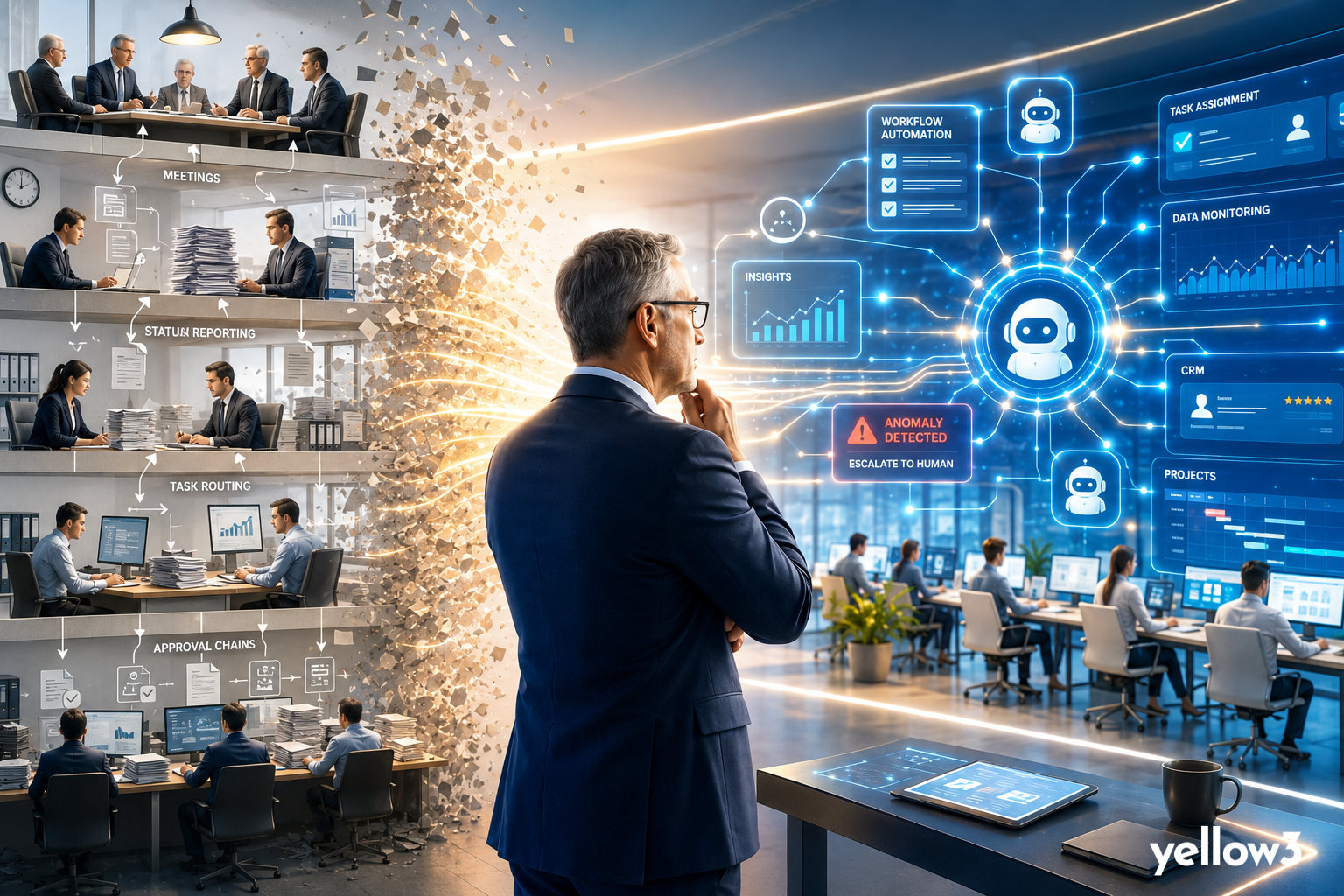
The uncomfortable truth is this: the job of a middle manager was always, at its core, an information problem. Someone at the top has a goal. Someone at the bottom has the capability to execute it. The manager exists to bridge that gap - to translate intent into action, track progress, surface blockers, and report back up the chain.
That gap is closing. Not because managers are bad at their jobs. Because software has gotten very good at theirs.
What autonomous agents actually do
An autonomous agent is not a chatbot. It is not a smarter notification system. It is software that holds a goal, monitors conditions, makes decisions within defined parameters, and acts - without waiting to be told.
The distinction matters. Traditional software is reactive. You open it, it waits. You input, it processes. You close it, it stops. An autonomous agent is different in kind. It perceives its environment, evaluates options, and executes. It does not need to be prompted at every step. It needs to understand the objective.
This is precisely what middle managers do. And it is precisely what they are being replaced by - not all at once, not dramatically, but steadily, function by function, meeting by meeting.
"Any role that relies on information routing will shrink. We expect a 10 to 20 percent reduction in traditional middle-management positions by the end of 2026." - IMD Business School
The functions that are already gone
Status reporting is gone. Autonomous agents connected to project management systems, CRMs, and communication tools can generate accurate, real-time status reports without a weekly meeting to produce them. The 45-minute Monday sync that exists to surface information the system already has - that meeting is a symptom of software that cannot hold context. Autonomous software holds context continuously.
Task routing is gone. When a customer inquiry arrives, an autonomous agent can classify it, determine the appropriate response or escalation path, and either handle it or route it - without a human triaging a queue. Salesforce's Agentforce platform is already doing this at scale across sales, service, and marketing functions.
Performance dashboards are gone. Not the dashboards themselves - the human whose job was to compile them. The agent monitors the metrics, flags anomalies, and surfaces insights. The analyst who spent three days a week pulling data to build a report that was out of date by the time it was read - that role is being redefined, fast.
What managers actually do that software cannot
Middle managers don't just coordinate. They translate. They absorb ambiguity from senior leadership and convert it into actionable direction for teams. They handle the employee who is disengaged, the cross-functional dispute over priorities, the client relationship that is souring for reasons that don't appear in any CRM.
That is real. And it matters. The question is not whether software can replace human judgment in complex, ambiguous situations. It cannot - not yet, and perhaps not ever in any meaningful sense.
The question is what proportion of a manager's actual working week is spent on those genuinely irreplaceable tasks, versus the coordination overhead that software is already absorbing.
Most honest managers, if pressed, would admit the ratio is uncomfortable.
The org chart as a symptom
The traditional organisational hierarchy was not designed around human capability. It was designed around information constraints. In a world where information moved slowly and unreliably, you needed layers of people to collect it, verify it, summarise it, and pass it up and down the chain. The org chart is an information architecture, built for a pre-software world and never fundamentally redesigned.
Autonomous software does not just automate tasks within that architecture. It makes the architecture itself redundant in places.
"The most successful organisations in 2026 will stop treating AI as a technology race and start treating it as a management revolution." - IMD Business School
The new shape of the organisation
This is not an argument that management disappears. It is an argument that management transforms.
The people who will thrive in the next decade of organisational life are not the ones who are good at managing information flow. They are the ones who are good at defining goals precisely, setting boundaries intelligently, and exercising judgment on the decisions that the system correctly escalates to a human.
That is a smaller group than the current middle management layer. It is also a more valuable one.
What this means if you are leading an organisation today
Gartner predicts that 40 percent of enterprise applications will embed AI agents by the end of 2026, up from less than 5 percent in 2025. That is not a gradual shift. That is an eight-fold increase in a single year.
The organisations that will find this disruptive are the ones that wait for it to happen to them. The ones that will find it liberating are the ones already asking a different question - not "how do we protect our existing structure" but "if we were designing this organisation from scratch today, knowing what software can now do, what would it look like?"
The manager who understands this is not threatened by autonomous agents. They become the person who knows how to deploy them, govern them, and hold them accountable.
That is a new kind of leadership. And it is the only kind with a long-term future.