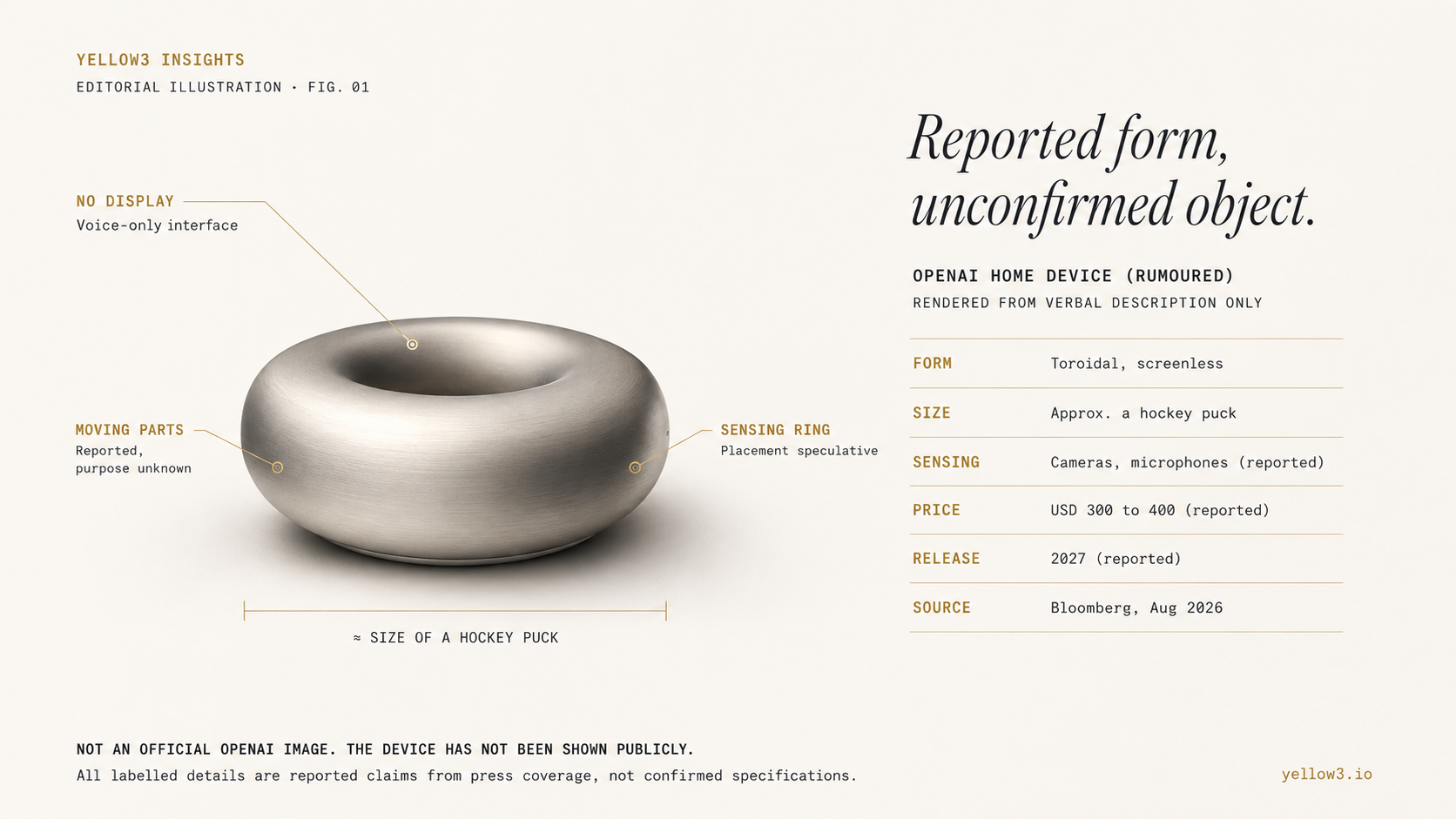
First, the facts, because in this story they are badly outnumbered by the renders.
Bloomberg reports that OpenAI's first consumer hardware product is being designed as a screenless device shaped roughly like a doughnut and about the size of a hockey puck, intended to move around the home with its owner. It is reportedly built from high-quality metal, equipped with cameras and sensors, and fitted with moving parts whose purpose has not been explained. The reported price is $300 to $400, with a target launch in 2027. Those details are unconfirmed, and some have already shifted: reporting in February put the expected price at $200 to $300. This is a product under development, not one sitting in a warehouse awaiting a launch event.
What OpenAI has confirmed is the much larger decision behind it. In July 2025 the company completed its acquisition of io, the hardware startup built by former Apple design chief Jony Ive and a team of former Apple designers and engineers, in an all-stock transaction valued at nearly $6.5 billion, the largest acquisition in OpenAI's history. Ive's studio LoveFrom remains independent but has taken on deep design responsibilities across the company. Before selling a single piece of consumer hardware, OpenAI made a multibillion-dollar commitment to becoming a hardware company. That matters far more than whether the first object looks like a doughnut.
There is also a complication. Apple sued OpenAI in July 2026, alleging that the company and two former Apple employees misappropriated trade secrets to accelerate its hardware programme, and claiming that more than 400 Apple alumni now work at OpenAI. This week OpenAI moved to dismiss, calling the suit baseless and pretextual, while Apple asked for a preliminary injunction; a hearing is set for October. Whatever the legal merits, the lawsuit is its own signal. Platform owners do not litigate against gadgets they consider harmless.
The product remains largely rumour. The strategic problem it appears designed to solve is not.
The most successful tenant in technology
By March 2026, ChatGPT had more than 900 million weekly active users and over 50 million paying subscribers, and OpenAI had closed a $122 billion funding round at an $852 billion valuation. Yet almost every consumer interaction with ChatGPT happens through hardware and operating systems controlled by someone else. On the iPhone, Apple decides microphone access, background permissions, notification behaviour and how deeply third-party intelligence can reach into the system. On Android, Google occupies the same position. OpenAI owns the intelligence. It does not own the device. In platform economics, that distinction eventually becomes expensive.
Other companies have paid the bill in different ways. Google reportedly paid Apple around $20 billion a year for default search placement, because being one settings menu away from the customer is economically different from being the default. Facebook, burned by the same dependence, bought Oculus and poured tens of billions into owning its own computing platform. Amazon pushed Alexa into millions of homes through cheap Echo hardware, and reporting later showed its devices business lost more than $25 billion between 2017 and 2021 doing it. Different companies, different economics, same lesson: if the customer relationship matters enough, eventually you start thinking about owning the door.
Read against that history, the $6.5 billion tells you how the $400 should be understood. OpenAI did not buy io because it needed a nicer Bluetooth speaker. It bought control: of the microphone, the sensors, the availability of the assistant, the depth of context it can hold, and ultimately the commercial relationship with the customer.
The strange shape makes strategic sense
Seen purely as a gadget, the reported device is easy to ridicule. Seen as an attempt at an AI-native computing category, the decisions become coherent, and the absence of a screen is the most important one. A screen forces immediate comparison with the smartphone, a category where Apple and Google have spent decades building silicon, operating systems, app ecosystems and habits. That would be a suicidal first battlefield. A screenless device sidesteps it and moves to territory where the phone is structurally weaker: persistent presence, conversational interaction, and computing that does not require a person to stop, unlock a rectangle and look at it. The phone is designed around applications. An AI-first device can be designed around intent.
The reported cameras, sensors and portability matter for the same reason. If the hardware can perceive where it is and what is happening around it, it can supply context that a ChatGPT app inside a phone does not continuously possess. This is where the device either becomes interesting or becomes pointless, because if the entire proposition is ChatGPT Voice without taking your phone out of your pocket, OpenAI has a problem.
It also creates the proposition's biggest risk. A screenless object with cameras and microphones, designed to live in the home, asks for a far more intimate trust decision than installing an app. If environmental awareness is the advantage, then trust becomes part of the industrial design: the light that shows when the camera is active may matter as much as the camera, the physical mute control as much as the model, and the answers to what stays local, what reaches the cloud and what can be deleted as much as either. The battle is not only for the room. It is for permission to perceive it.
The Humane tax
Every AI hardware launch now pays a tax to the memory of Humane, whose $699 AI Pin received brutal reviews and whose remains went to HP for $116 million within a year of launch. The comparison is unavoidable but incomplete. Humane had to establish a brand, teach an interaction model, prove a use case and build hardware simultaneously, on borrowed models, against the phone. OpenAI does not need to prove that people want conversational AI; more than 900 million people demonstrate it weekly. It has to prove something harder, the question Humane never answered: why does conversational AI need its own physical object? That is not a question aluminium can answer, however beautifully it is machined.
Apple is not waiting
The timing sharpens everything. In June, at WWDC, Apple unveiled Siri AI, a substantially more capable assistant with personal context and onscreen awareness, reportedly powered in part by Google's Gemini models. Sit with that arrangement for a moment: Apple is renting intelligence from Google while suing OpenAI over hardware. Every layer of this fight is about the same thing, who owns the interface and who merely supplies it.
The race OpenAI is entering is therefore not against the old Siri or Alexa. Apple, Google, Meta, Amazon and OpenAI are converging on the same prize: an AI present enough, personal enough and trusted enough to become the interface between a person and the digital world. The incumbents start with hardware, operating systems and installed bases. OpenAI starts with the relationship people already have with ChatGPT, mediated, for now, by somebody else's machine.
What to watch
Five signals between now and launch will tell whether this is an expensive gadget or a platform attempt. First, what the hardware can do that a phone cannot; if the answer is voice chat with fewer taps, the product is in trouble. Second, memory and context, and how much control users get over both. Third, privacy architecture: physical controls, local processing, recording indicators, retention. Fourth, the developer story: a device running only OpenAI's experiences is a product, while one others can build on is a platform. Fifth, Apple's behaviour, in court and in the operating system. Platform owners rarely announce they are worried about losing an interface. They change the rules around it.
The doughnut will get the jokes. The renders will get the views. But the question underneath is the one every major platform company eventually confronts: how comfortable are we building our future on somebody else's machine? Google paid for defaults. Meta bought its way in. Amazon subsidised the door. OpenAI appears to have chosen the hardest answer: build the machine. The $400 doughnut is not the story. The escape route is.
yellow3 Insights covers artificial intelligence, digital competitiveness and platform strategy.
Illustration disclosure: The image accompanying this article is an editorial rendering produced by yellow3 from published descriptions of OpenAI's reported hardware. It is not an official OpenAI image. OpenAI has not publicly shown the reported device.