Live instruments, not opinions.
yellow3 publishes original evidence on emerging technology, regulation and markets. Each instrument starts with a question that can be measured, keeps the sources visible and records what changed over time.
Where AI demand is actually flowing.
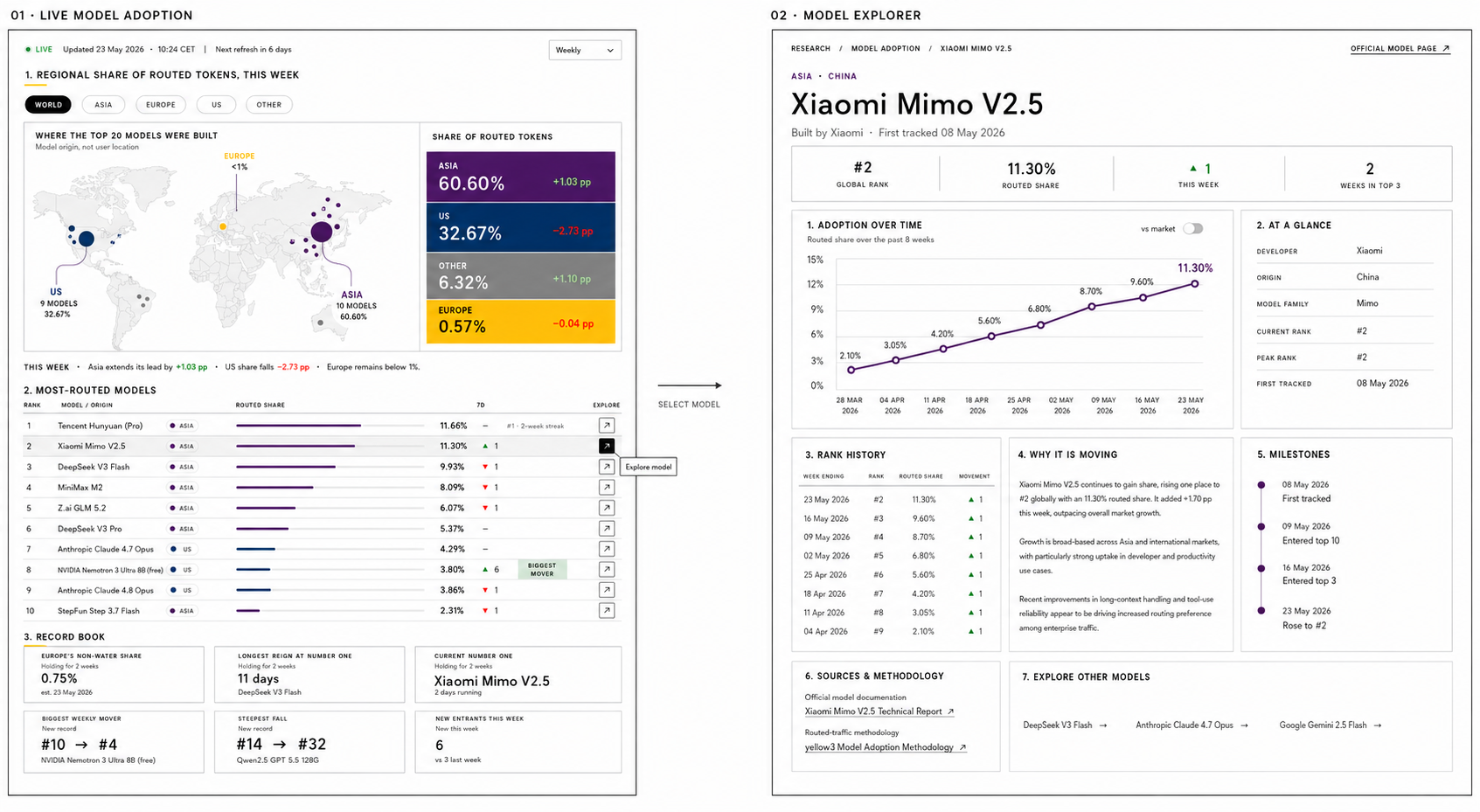
AI Model Adoption tracks routed AI usage by where the models were built, not where the user sits. It preserves regional share, model movement, a public record book and yellow3's weekly call.
Announcements tell you what launched. Benchmarks tell you how a model performed under a test. Routed usage tells you where real demand is moving inside the measured source.
Asia, the US, Europe and other origins measured by model origin.
A weekly ranking of the models receiving routed traffic.
Streaks, movers and changes preserved rather than disappearing into the news cycle.
yellow3 makes a dated weekly call and grades it afterwards.
Five public instruments. Five different questions.
The shelf should grow only when a question deserves a maintained instrument. A new page is not research infrastructure by itself.
Evidence should survive the conclusion.
A yellow3 finding should still make sense when somebody asks where did that come from? That means the source, date, uncertainty and later outcome remain visible.
Dated evidence
Sources are attached to the finding, not hidden behind the conclusion.
Measurable thesis
Where possible, the question is framed so reality can later prove it right or wrong.
Public grading
Calls are preserved and graded. The record does not reset when the story changes.
Visible uncertainty
Not established is different from disproven. The research should say which one it means.
The Digital Product Passport market can be inspected.
yellow3 maps organisations supplying Digital Product Passport capability and keeps the source and date behind the facts. Suppliers cannot pay to rank higher, buy a better finding or purchase verification.
From signal to decision.
The Decision Intelligence Framework turns a complex topic into a sequence that separates evidence from interpretation and interpretation from action. The detailed method stays public so readers can understand how a conclusion was reached.
Research is useful when it changes what you do next.
Explore the live instruments, inspect the underlying evidence and use the method where the decision matters.