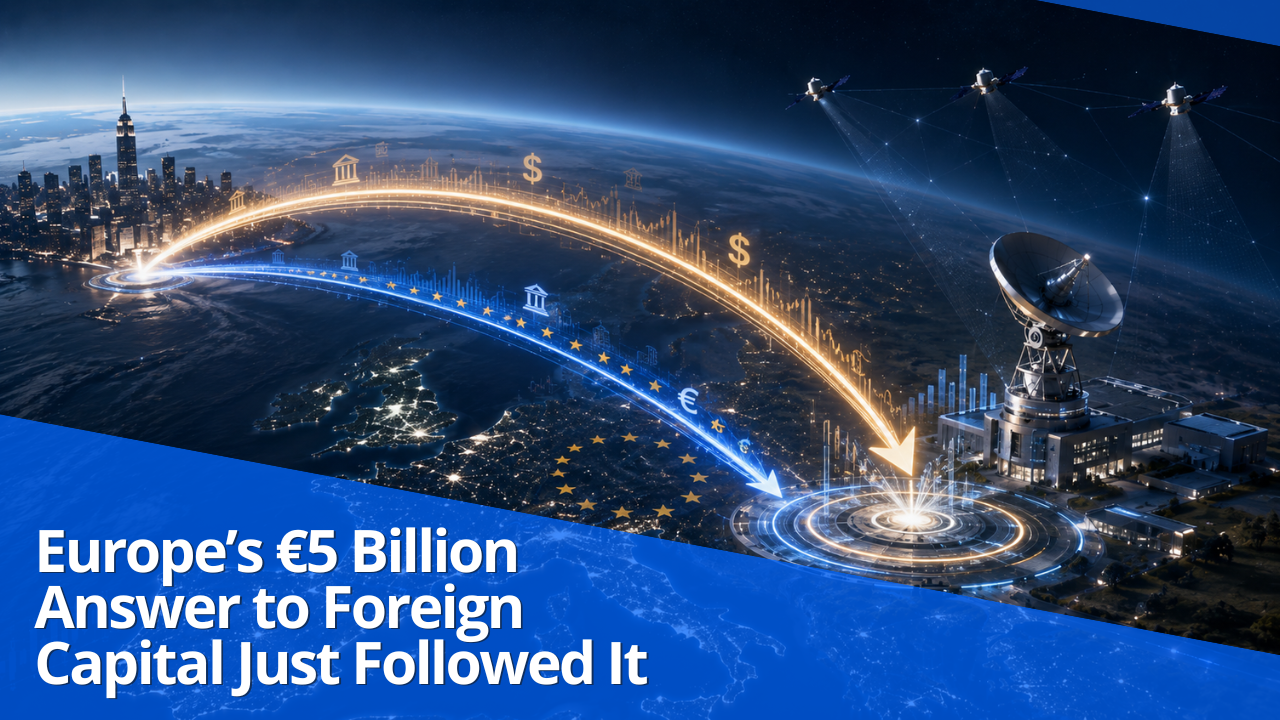
Europe has spent years diagnosing its scaleup problem.
It creates strong technology companies. Then, when those companies need hundreds of millions to become global businesses, much of the capital comes from somewhere else.
The European Commission has now built its biggest direct answer to that problem: the Scaleup Europe Fund, a privately managed growth fund targeting approximately €5 billion, anchored by a €1 billion commitment from the Commission and designed to make investments of €100 million and above in strategically important European technology companies.
Artificial intelligence. Semiconductors. Quantum. Robotics. Energy. Space. Biotechnology. Advanced materials.
This is not supposed to be another small European innovation programme.
It is supposed to give Europe financial weight.
And the Commission has been remarkably explicit about why it is needed.
Its own explanation says the increasing dominance of foreign investors in large European funding rounds creates risks including strategic dependency, company relocation, foreign control and talent outflow. The fund is supposed to help Europe's most promising technology companies raise capital through what the Commission calls “major, European-led funding rounds.”
The EU Startup and Scaleup Strategy goes further. It says the Scaleup Europe Fund is intended to contribute to Europe’s technological sovereignty and economic security.
Then came the first investment.
Europe picked the right company
The company is ICEYE.
On almost every strategic measure, it is difficult to imagine a more European first investment.
ICEYE was founded in Finland in 2014. It owns and operates what it describes as the world’s largest synthetic aperture radar satellite constellation. Seven European governments had procured sovereign satellite systems from the company by June 2026.
It recently delivered a fully operational sovereign space capability to Poland twelve months after contract signature.
And this is no fragile startup being kept alive by policy money.
ICEYE reported more than €250 million in 2025 revenue, more than €100 million in EBITDA and a contracted backlog above €1.5 billion. Those figures are company-reported and unaudited, but they describe a business already operating at substantial scale. Production was running at around 50 satellites a year, with the company targeting 100 annually by 2028.
ICEYE even describes itself as “natively European.”
If the purpose of the Scaleup Europe Fund is to help keep important European technology companies European, ICEYE is an entirely defensible place to start.
The company is not the problem.
The round is.
The Americans were already there
On 9 June 2026, ICEYE announced a Series F funding round exceeding €1 billion.
The primary financing was €450 million at a valuation above €10 billion. Together with a secondary transaction, the total round exceeded €1 billion.
And ICEYE was clear about who was leading it.
General Atlantic.
The New York-headquartered global growth investor.
ICEYE’s announcement named additional investors including Finland’s Solidium, Tesi, Varma, Ilmarinen, Lifeline Ventures and Nokia, alongside Qatar Investment Authority and the American investment firm TCV.
The Scaleup Europe Fund was not named.
There was a straightforward reason for that. At the time ICEYE announced its round, the fund had not yet completed its legal establishment. The Commission completed the final legal steps on 4 August. The following day, EQT announced the Scaleup Europe Fund’s first investment.
EQT described the fund as having co-led ICEYE’s Series F.
That description matters, and it should not simply be dismissed.
Financing rounds evolve. Investors can join before closing. Roles can change. A second investor can become a co-lead after a transaction has first been announced. Both the June and later announcements described the transaction as subject to regulatory approvals and closing conditions.
So there is no need to manufacture a contradiction where one may not exist.
But the chronology still tells us something important.
The €1 billion round had already been announced.
Its valuation had already been disclosed.
General Atlantic had already been publicly identified as lead investor.
Europe’s new answer to foreign dominance arrived afterwards.
The first test of Europe’s new ability to lead a major technology funding round began with Europe joining one that had already been announced under American leadership.
The word that matters is “led”
It would be easy to turn this into an argument against foreign investment.
That would be the wrong argument.
European companies should be able to raise money from the best investors in the world. A European scaleup becoming attractive to General Atlantic, TCV, QIA and major European institutional investors is not evidence of failure. It is evidence that the company has become globally important.
The policy question is different.
The Commission did not create the Scaleup Europe Fund merely because European companies were failing to raise capital.
Its own diagnosis specifically identifies the growing dominance of foreign investors in large funding rounds as a problem. It links that dominance to strategic dependency, relocation, foreign control and talent outflow.
And its stated remedy is not merely European participation.
It says European-led rounds.
There is a meaningful difference.
A participant supplies capital.
A lead investor typically has greater influence over how a round is assembled, negotiated and syndicated. It may help establish terms, bring other investors into the transaction and become a more significant actor in the relationship with the company.
If Europe’s objective is simply to put substantially more European money onto the cap tables of strategic companies, the ICEYE investment fits perfectly.
If the objective is to change who has the financial capacity to organise and lead Europe’s biggest technology rounds, it is a much less convincing first demonstration.
That distinction is the real story.
The fund has two jobs
The Scaleup Europe Fund is trying to solve two related but different problems.
The first is a capital problem.
The Commission’s 2025 Startup and Scaleup Strategy identifies a persistent European financing gap for high-risk, capital-intensive technologies requiring investments above €100 million. Europe does not have enough growth capital at the scale its best companies increasingly require.
A €5 billion fund can help change that.
The second is a strategic control problem.
If the largest rounds consistently require foreign investors to supply, structure or lead the capital, Europe can create successful companies without creating a financial ecosystem capable of keeping strategic influence around them.
The Scaleup Europe Fund can contribute to solving both problems.
But simply investing solves the first more directly than the second.
That is why the first transaction matters.
The tension is built into the fund
There is no evidence that EQT has done anything wrong here.
Quite the opposite.
EQT was selected precisely because the Commission wanted an experienced, independent commercial investor rather than another politically directed EU investment programme.
The fund is designed on commercial terms with market-standard governance. The Commission says investment decisions will be made by EQT on commercial and merit-based grounds, in accordance with the fund’s Investment Guidelines. The Commission and the other investors participate in governance as investors, but they will not direct individual investment decisions.
That independence is understandable.
A growth fund competing for Europe’s best companies cannot operate effectively if every transaction becomes a political negotiation in Brussels.
But it creates a tension that deserves attention.
One part of the architecture has a strategic objective: strengthen technological sovereignty, reduce foreign dominance and support European-led rounds.
Another part delegates individual investment decisions to an independent manager operating on commercial merit.
The public material does not yet make clear who owns the trade-off when those two objectives point in different directions.
Imagine two possible deals.
One offers exceptional financial returns but leaves European capital as a minority participant in a foreign-led transaction.
The other is commercially sound but gives the European fund the opportunity to anchor the round, set the pace and bring European institutional capital alongside it.
Does the fund prefer one?
Should it?
And if European leadership carries some strategic value of its own, where is that value expressed in the investment process?
These questions become more important as the fund moves beyond its first investment.
ICEYE is actually the easy sovereignty case
There is another reason ICEYE is an interesting first test.
Its corporate value and much of its strategic capability sit in the same place.
ICEYE owns satellites. It operates a constellation. It sells sovereign satellite systems. Buying equity in ICEYE means buying into a company that itself owns and controls significant physical technology infrastructure.
That relationship becomes much less straightforward in sectors such as artificial intelligence.
A European AI company can be European-founded, European-headquartered and European-owned while depending heavily on semiconductor supply chains, cloud infrastructure, computing capacity, foundation models or other critical technologies controlled outside Europe.
In those companies, buying European equity does not automatically create European technological sovereignty.
The Commission lists AI, quantum technologies, semiconductors, robotics, energy, space, biotechnology, medical technology and advanced materials among the strategic areas relevant to the fund.
So the sovereignty question is going to get harder.
ICEYE, with European roots and substantial owned infrastructure, should have been one of the simplest cases in which capital and strategic control could align.
That makes the structure of its financing particularly revealing.
A good fund is not automatically a sovereignty strategy
The Scaleup Europe Fund may become a very good investment fund.
Europe genuinely needs larger pools of growth capital. A target size of approximately €5 billion, with individual investments expected at €100 million and above, is material. EQT has significant experience. European pension, institutional and strategic capital is participating. The Commission itself is committing €1 billion.
That matters.
But the Commission has asked the instrument to do something more ambitious than generate returns.
The EU Startup and Scaleup Strategy says it should contribute to Europe’s technological sovereignty and economic security. The fund’s own materials say it should help address foreign investor dominance and support major European-led funding rounds.
Those claims create a higher standard.
The first investment does not prove the fund will fail that standard.
One deal could never establish that.
But it gives Europe a useful question by which to judge the next ten.
Is the Scaleup Europe Fund designed to put more European money into the world’s biggest rounds, or to make Europe capable of leading them?
Both would be progress.
They are not the same thing.
And if leadership really is part of the mission, success should eventually be visible in the transactions themselves.
European capital should sometimes arrive first.
It should sometimes anchor the round.
It should sometimes set the terms.
It should be capable of bringing other investors behind it rather than consistently arriving behind them.
Europe finally has an instrument designed to operate at that scale.
That is significant.
But its first transaction demonstrates something narrower than the ambition that created it.
Europe can now afford to join the table.
The next question is whether it intends to lead it.
Sources
European Innovation Council, European Commission, Scaleup Europe Fund. Fund rationale, target size, Commission commitment, investment range, strategic sectors, foreign investor dominance, European-led funding rounds and fund-manager independence.
European Commission, The EU Startup and Scaleup Strategy: Choose Europe to start and scale, COM(2025) 270 final, 28 May 2025. Scaleup financing gap, technological sovereignty and economic security objectives.
EQT, EQT selected to lead the Scaleup Europe Fund, 18 May 2026. Target fund size, investment strategy, commercial governance, manager independence and founding investors.
EQT, EQT’s Scaleup Europe Fund makes first investment: co-leads €1 billion funding round in ICEYE, 5 August 2026. First investment and co-lead description.
ICEYE, ICEYE leads a new era of sovereign intelligence from space with €1B funding round, 9 June 2026. General Atlantic lead, financing structure, valuation, investor list, company financial figures and sovereign-system deployments.
Note on the record: ICEYE’s 2025 revenue, EBITDA and backlog figures are company-reported and unaudited. ICEYE’s 9 June announcement identifies General Atlantic as lead investor and does not name the Scaleup Europe Fund. EQT’s later announcement describes the Scaleup Europe Fund as co-lead. Both descriptions are reported here because they refer to different points in the transaction’s development and are not necessarily mutually exclusive.