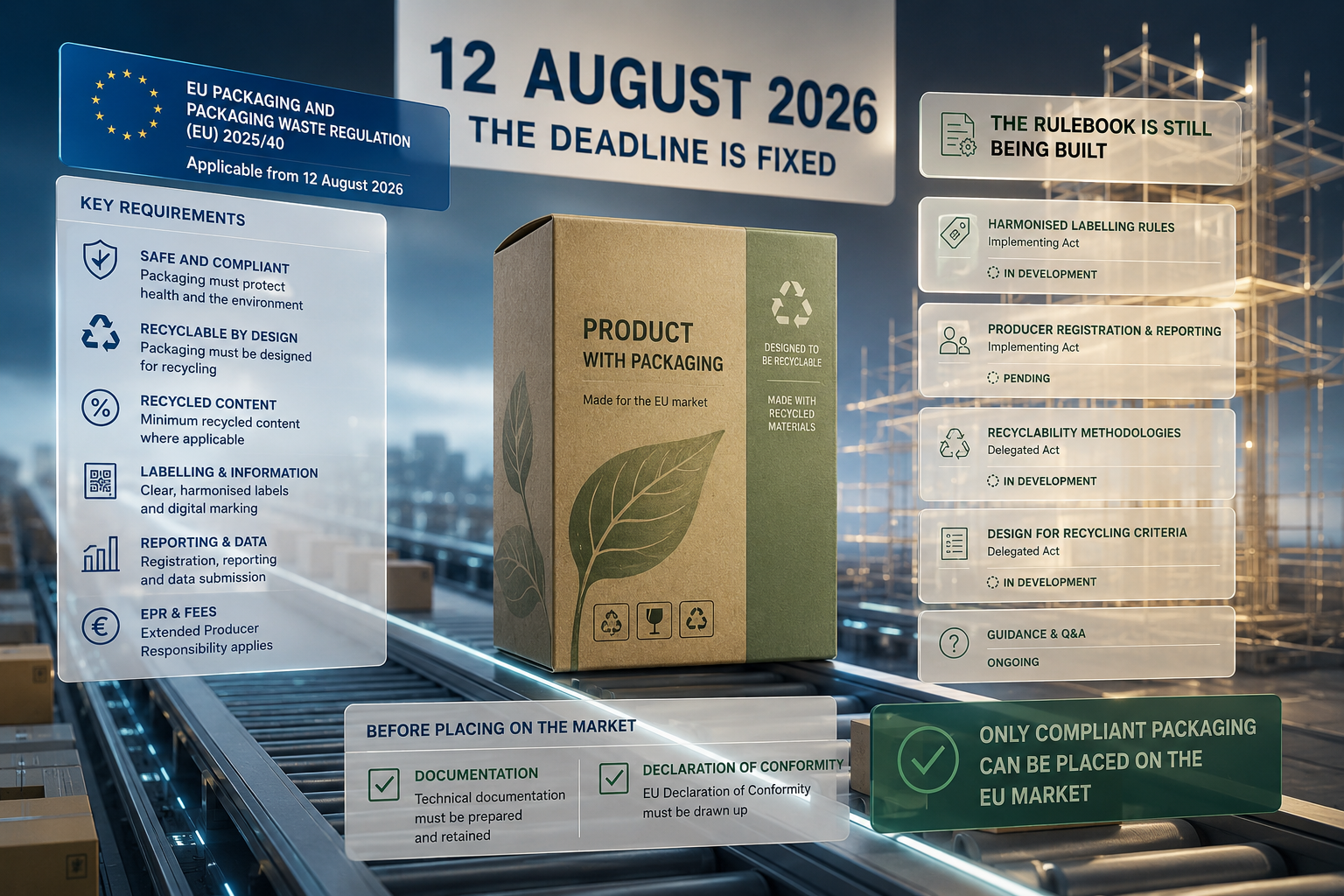
On 12 August 2026, the Packaging and Packaging Waste Regulation, Regulation (EU) 2025/40, began applying across the European Union.
It is a major change. Unlike the directive it replaces, the PPWR is directly applicable in every Member State. Manufacturers may place packaging on the market only if it conforms with the applicable requirements in Articles 5 to 12. Before doing so, they must carry out the required conformity assessment and prepare technical documentation. Where compliance has been demonstrated, an EU Declaration of Conformity must be drawn up.
For single-use packaging, that documentation and declaration generally have to be retained for five years. For reusable packaging, ten.
The old Packaging and Packaging Waste Directive, Directive 94/62/EC, was repealed from the same date, although several of its provisions deliberately continue during transition periods established by the new Regulation.
On paper, industry had time.
The PPWR entered into force on 11 February 2025. Its general application date, 12 August 2026, was written into the Regulation from the beginning. That looks like an eighteen-month preparation window.
But that is not quite how modern product regulation works.
There is the date on which the law is known.
Then there is the date on which the requirement becomes applicable.
And somewhere between those two sits another date that can matter just as much: the point at which a business actually has enough final technical detail to know exactly what it must build, test, document, collect and prove.
Those dates are not the same.
One regulation, several clocks
The easiest mistake with PPWR is to talk about 12 August 2026 as if somebody flipped a single regulatory switch.
They did not.
Some obligations are now live. Others have their own transition periods. Others depend on delegated acts, implementing acts, methodologies or standards that arrive later.
The restrictions on PFAS in food-contact packaging are a good example of something that became real immediately. From 12 August 2026, food-contact packaging cannot be placed on the EU market above the PFAS concentration limits specified in Article 5(5).
Yet the European Commission's own guidance acknowledges an awkward operational fact: there is currently no harmonised EU methodology for testing PFAS in food-contact packaging. Instead, the Commission recommends a stepwise approach based on available analytical methods so that authorities can enforce a legal limit that is already applicable.
That is a real example of the distinction between a legal deadline and an operationally mature rulebook.
Labelling shows the opposite.
The PPWR required the Commission to adopt implementing acts by 12 August 2026 establishing harmonised labels, specifications and digital-marking methodologies. But the obligation on economic operators to use the harmonised material-composition label does not generally begin on 12 August 2026.
It begins from 12 August 2028 or 24 months after the relevant implementing acts enter into force, whichever is later. Reusable-packaging labelling has a similar later-of mechanism.
So an outstanding labelling act does not leave industry with a negative preparation window. The Regulation deliberately moves the downstream deadline with it.
Recyclability has another clock again. The PPWR establishes the direction now, but the design-for-recycling performance regime is tied to future delegated acts and generally applies from 2030 or 24 months after those acts enter into force, whichever is later.
This is the regulatory environment companies actually have to manage.
Not one deadline.
A stack of them.
The eighteen-month window is real. The actionable window is different.
That distinction matters because it changes what we should learn from this week.
The simplistic conclusion is that companies had eighteen months and should simply have started earlier.
Sometimes that will be true.
But it misses the structural problem.
A business can start organising ownership, suppliers, systems, evidence and data long before every technical specification exists. What it cannot necessarily do is complete implementation against a specification that has not yet settled.
The Commission's formal PPWR guidance addresses precisely the kinds of questions that determine how the legislation works in practice: who is the manufacturer, who is the producer, how EPR responsibilities move across borders, how PFAS restrictions should be enforced, and how transitional provisions should be interpreted.
The PPWR itself also required the Commission by 12 February 2026 to adopt implementing acts establishing the format for producer registration and reporting, including the granularity of the data and packaging categories to be reported.
And on 11 August 2026, one day before general application, the Commission said publicly that it was still advancing work on the necessary secondary legislation.
That does not mean the PPWR was somehow unknowable until the last minute. It was not.
It means something more useful:
The nominal regulatory window and the actionable implementation window are different things.
The first begins when legislation is adopted.
The second becomes progressively clearer as standards, delegated acts, implementing acts, official guidance, testing methodologies and enforcement interpretations arrive.
For companies subject to the law, that distinction is becoming part of compliance itself.
The Digital Product Passport is already following the pattern
This matters beyond packaging because the same regulatory machinery is now assembling around the Digital Product Passport.
And here the dates are worth getting exactly right.
On 14 July 2026, the Commission adopted Implementing Decision (EU) 2026/1736 covering six horizontal standards for the Digital Product Passport system. It was published in the Official Journal on 15 July, giving those standards their formal role within the ESPR conformity framework.
On 16 July, the Commission adopted Implementing Regulation (EU) 2026/1778 establishing the practical arrangements for the DPP Registry. It was published on 17 July and entered into force twenty days later, on 6 August 2026.
On 20 July, the Commission launched the Registry itself together with its testing environment. It includes the infrastructure for registering product identifiers and associated metadata, while the actual product-passport data remains decentralised.
The Registry architecture includes a secure user interface, an API, a verification platform and mechanisms for validating the existence and completeness of passport registrations.
But this is where the comparison with packaging has to be precise.
The first battery-passport obligation does not arrive six days later.
It arrives on 18 February 2027 for LMT batteries, industrial batteries above 2 kWh and electric-vehicle batteries.
So the horizontal DPP infrastructure was not finalised six days before its first major product deadline.
It was finalised roughly six to seven months before it.
That is a very different claim.
It is also still a remarkably short period when the job is not merely installing software, but identifying product data across supply chains, assigning ownership, resolving gaps, integrating systems, onboarding suppliers, establishing evidence, testing outputs and proving that the whole structure survives contact with reality.
What the DPP supply side should learn
Packaging is therefore not evidence that Brussels gives industry six days to comply.
It demonstrates something more commercially important for the companies building DPP platforms.
Your product is not the passport. It is additional usable time.
The Commission is building the common infrastructure.
The Registry already provides a user interface and API for registration. It verifies users, registers identifiers and metadata, performs system checks and provides the central infrastructure through which DPP registrations can be recognised. Product information itself remains decentralised.
That changes the value proposition for commercial DPP providers.
"Create a passport" is not enough.
"Register your passport" will increasingly sound like infrastructure.
The difficult work sits before and around that transaction:
- getting data out of suppliers;
- knowing where evidence came from;
- mapping information to changing regulatory schemas;
- identifying what is missing;
- deciding who is responsible for it;
- maintaining versions;
- integrating product and enterprise systems;
- handling new delegated acts;
- and being able to demonstrate, years later, why a particular data point was considered valid.
The most valuable DPP provider may therefore be the one that turns six months of regulatory clarity into twelve months of customer preparedness because the customer's information was already structured before the final schema arrived.
That is a much stronger product than passport generation.
Build for a moving specification
The Registry rules themselves point toward the architecture required.
Implementing Regulation 2026/1778 provides for versioned registration data and says that the data model applicable to each product group should, where available, be based on the relevant delegated acts or other applicable Union legislation.
That should be a design instruction for every DPP platform.
Do not hard-code tomorrow's legislation into today's product.
Separate evidence from interpretation.
Separate the source data from the regulatory output.
Version schemas.
Version findings.
Preserve provenance.
Make regulatory requirements configurable.
A supplier that has to rebuild its data architecture every time a product-specific delegated act changes will spend the mandatory years maintaining software instead of serving customers.
The platform that can absorb a regulatory change centrally and remap existing customer evidence against it has a very different economic model.
Collect before you know the final shape
There is another implication.
Waiting for every specification to become final before engaging the supply chain is too late.
You may not know the final field structure for a future passport. You can still know that material composition, manufacturer identity, identifiers, technical characteristics, sustainability information, evidence sources and supplier responsibility are not going to materialise automatically when a delegated act is published.
The rational strategy is to collect high-quality source evidence early and map it later.
That means DPP software should distinguish between what the company knows and what the current regulation requires it to publish.
Those are different layers.
If the regulatory schema changes, the evidence should survive.
If the evidence is welded to the output schema, every regulatory change becomes another data-collection exercise.
That distinction may turn out to be one of the most important architectural choices in the entire DPP market.
A provider's own compliance is part of the product
There is also a lesson for the DPP vendors themselves.
The ecosystem is becoming regulated infrastructure, not simply another SaaS category.
The ESPR already established requirements around DPP availability and backup arrangements, while the Registry framework now introduces verified actors, access controls, registration records, versioning and retention rules for Registry data.
For buyers, that changes the procurement question.
It is no longer only:
What features do you have?
It becomes:
Who controls my data?
What happens when your company disappears?
Can I move?
Where is the evidence stored?
Who can alter it?
What is retained?
What can an authority verify independently?
Can you demonstrate that your own operation meets the rules you are helping me satisfy?
When thousands of companies eventually enter the market under deadline pressure, trust will not be a brand adjective.
It will be infrastructure.
The clock that actually matters
The lesson from 12 August is therefore not that Europe announced an eighteen-month transition and secretly delivered six days.
The law does not support that claim.
The more consequential lesson is that there is no single compliance clock anymore.
There is a legislative clock.
A delegated-act clock.
A standards clock.
An implementing-act clock.
A guidance clock.
A supplier-data clock.
An integration clock.
And finally, an enforcement clock.
They do not move together.
For businesses, the answer is not simply to "start earlier." It is to build an operating model capable of beginning before everything is known.
For technology providers, the commercial opportunity is even clearer.
Do not sell certainty about rules that can still move.
Sell the machinery that allows the customer to keep moving when they do.
Packaging started applying across Europe this week.
The Digital Product Passport industry should treat it as a rehearsal, not because the regulations are the same, and not because their deadlines are six days apart.
Because the pattern is the same:
the date is fixed long before the implementation environment is finished.
The companies that understand that distinction will arrive at the deadline with evidence already organised, systems already connected and decisions already traceable.
Everyone else will start reading the final specification when the clock is already running.
Sources
- Regulation (EU) 2025/40 on packaging and packaging waste
- European Commission guidance on Regulation (EU) 2025/40
- European Commission: New EU rules on packaging enter into application, 11 August 2026
- Commission Implementing Decision (EU) 2026/1736 on harmonised DPP standards
- Commission Implementing Regulation (EU) 2026/1778 establishing the DPP Registry arrangements
- Regulation (EU) 2023/1542 on batteries and waste batteries