For years, the Digital Product Passport has been discussed as something coming.
A future requirement. A future QR code. A future data problem for sustainability, compliance and IT teams to solve before some future deadline.
That description is becoming dangerously outdated.
On 19 July 2026, a significant obligation under the EU's Ecodesign for Sustainable Products Regulation started applying to large enterprises. From that date, companies covered by the rule can no longer destroy specified categories of unsold apparel, clothing accessories and footwear unless one of a defined set of derogations applies.
This was not, technically, a Digital Product Passport deadline.
That is exactly why it matters.
Because while companies are asking when "the DPP deadline" arrives, the European product-regulation system surrounding the passport is already switching on, obligation by obligation.
And some of those obligations are no longer plans.
They are law.
The date everyone has circled
The clearest Digital Product Passport deadline remains batteries.
From 18 February 2027, every electric-vehicle battery, light means of transport battery and industrial battery above 2 kWh placed on the EU market or put into service must have an electronic battery passport under Article 77 of Regulation (EU) 2023/1542.
That is a hard date.
It is written into legislation already published in the Official Journal. It is not a Commission working-plan estimate, consultation timetable or industry prediction.
And the European Commission now has the infrastructure waiting for it.
On 20 July 2026, the EU's central Digital Product Passport Registry became operational. The Registry provides the common EU index for DPPs while the underlying passport data remains decentralised under the responsibility of the economic operator, either self-hosted or managed through a DPP service provider.
The Commission's own registry timeline treats the battery passport as the first deadline the new infrastructure exists to serve.
So 18 February 2027 deserves to be on the whiteboard.
The problem starts when that date becomes shorthand inside a company for something it is not:
"The DPP deadline."
There isn't one.
The deadline that has already arrived
The Ecodesign for Sustainable Products Regulation has been in force since 2024.
But Article 25 contains a specific date that matters now.
From 19 July 2026, the destruction of unsold consumer products listed in Annex VII is prohibited. The prohibition currently covers specified apparel, clothing accessories and footwear. Micro and small enterprises are excluded, while the prohibition applies to medium-sized enterprises from 19 July 2030.
For a large enterprise in fashion or footwear, this is no longer a readiness discussion.
It is an operating requirement.
There are legitimate circumstances in which covered unsold goods can still be destroyed. Commission Delegated Regulation (EU) 2026/296 defines them, ten in total.
They include dangerous or legally non-compliant products, substantiated intellectual-property issues, certain contractual IP restrictions, products where protected or inappropriate branding cannot feasibly be removed, damaged or contaminated goods that cannot reasonably be repaired or refurbished, and manufacturing or design defects that cannot feasibly be repaired.
There is also a narrowly defined donation route, which only applies once none of the grounds above do.
Where the earlier derogations do not apply, a company can rely on failure to donate if the products were offered to at least three suitable social-economy entities in the EU, or made available for donation through an easily accessible company webpage for at least eight weeks, and were not accepted. Two further, narrower grounds cover social-economy entities that received a donation but couldn't find a recipient for it, and goods already prepared for reuse by a waste operator that also found no buyer.
But the important word is not "exception."
It is evidence.
A company relying on one of these derogations must retain supporting documentation for five years after the products are destroyed. If a competent authority asks for it, the documentation must be made available electronically within 30 days.
Think about what that means operationally.
If a large apparel company destroyed covered unsold stock after 19 July because it was damaged, because a licence had expired, because donation failed, or because another derogation applied, someone needs to be able to prove that.
Not explain it.
Not reconstruct it later.
Prove it.
And if covered goods have been destroyed since 19 July without a valid derogation and the evidence required to substantiate it, the compliance problem is not waiting in 2027 or 2028.
It exists now.
This is not a DPP rule. That is the point.
Article 25 does not require a Digital Product Passport.
It would be misleading to call 19 July a DPP compliance deadline.
But that distinction reveals the bigger problem.
Companies are increasingly using "DPP" as shorthand for a much broader transformation in European product regulation, data, traceability and evidence.
Those things do not all start on the same day.
A company could have an impressive DPP pilot and still fail to document destruction of unsold stock correctly.
It could select a passport platform while having no reliable mechanism for collecting information from its suppliers.
It could be technologically ready for a product category whose delegated act has not yet been adopted.
And it could spend the next year preparing for a passport while overlooking an adjacent obligation that already applies to its products today.
So the boardroom question:
"When is our DPP deadline?"
is becoming the wrong question.
A better one is:
"Which product obligations already apply to us, which ones have a legally fixed future date, and which ones are still being designed?"
Those are three very different categories.
There is already more than one DPP deadline
Batteries are simply the first obvious example.
They are not the only product category with a Digital Product Passport already written into adopted EU law.
Under the new Detergents Regulation, manufacturers will have to create a Digital Product Passport before placing detergents or end-user surfactants on the market. The Regulation applies from 23 September 2029.
Toys now have their own statutory DPP requirement as well.
Under Regulation (EU) 2025/2509, a manufacturer must create a Digital Product Passport before placing a toy on the market. That Regulation applies from 1 August 2030. The toy passport will also connect to the same EU DPP Registry infrastructure.
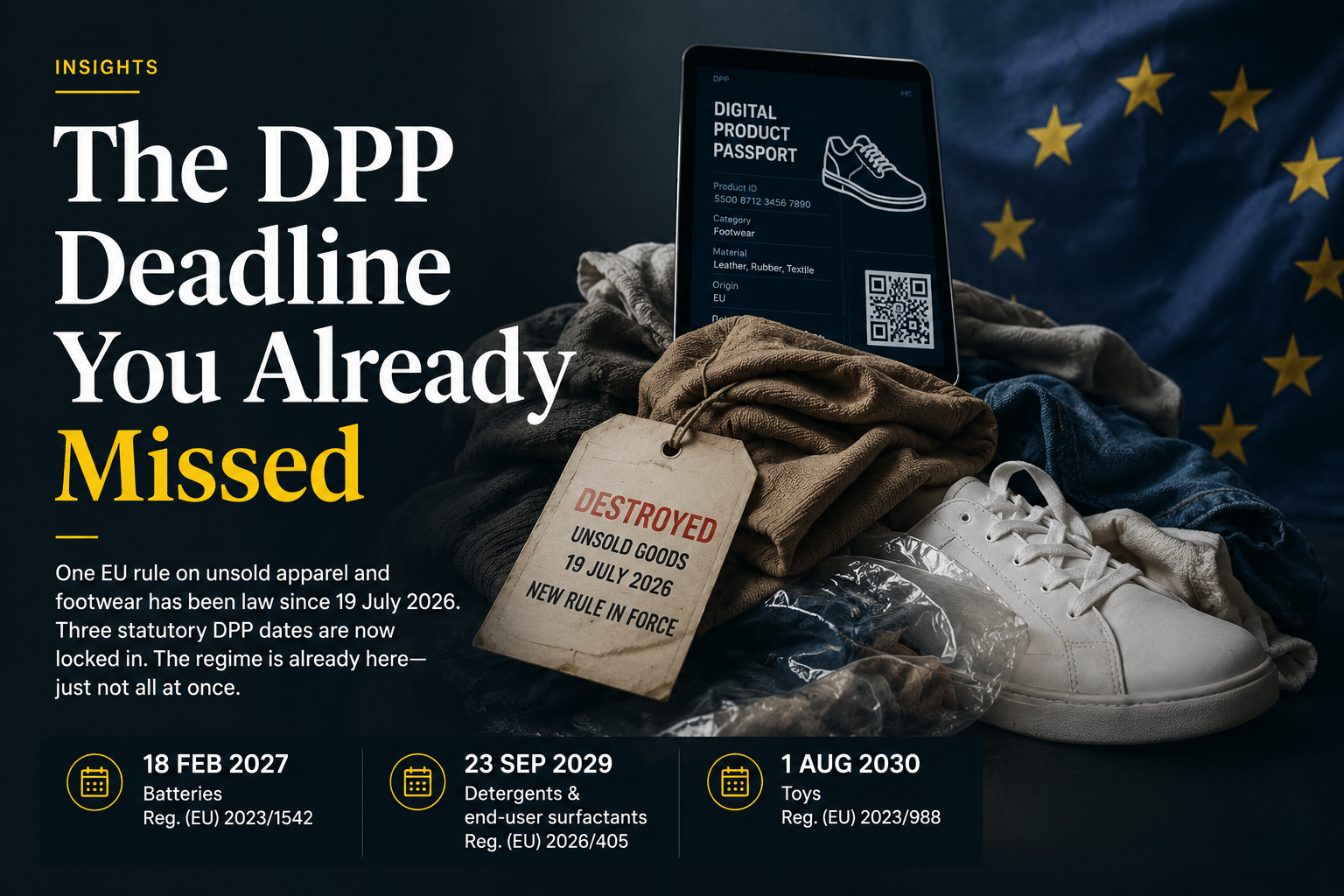
So the legally fixed DPP calendar already includes at least:
18 February 2027: batteries.
23 September 2029: detergents and end-user surfactants.
1 August 2030: toys.
And those requirements come from different pieces of EU legislation.
Meanwhile, the Commission is developing product-specific requirements under ESPR for major categories including iron and steel, with further product groups to follow.
The wider EU DPP implementation programme also includes parallel regimes outside ESPR, including construction products under the Construction Products Regulation. The Commission's published DPP timeline is explicit that much of this future timetable remains indicative. For ESPR delegated acts, Article 4(4) provides economic operators with a transition period of at least 18 months from entry into force, except in specifically justified cases.
That distinction matters.
A working-plan date is not the same thing as a statutory compliance deadline.
A delegated act expected in Q4 is not the same thing as a delegated act published in the Official Journal.
And "expected in 2028" is not law.
For buyers, legal teams and boards, those labels matter more than another colourful DPP roadmap.
July changed something else
There is another reason the old "DPP is coming" language no longer works.
The technical infrastructure moved.
On 15 July 2026, references to six harmonised European DPP standards were published in the Official Journal.
They cover data-exchange protocols, unique identifiers, data carriers, storage and persistence, lifecycle and search APIs, and system interoperability:
EN 18216:2026, EN 18219:2026, EN 18220:2026, EN 18221:2026, EN 18222:2026 and EN 18223:2026.
This is not just another standardisation milestone.
Under Article 41 of ESPR, a Digital Product Passport conforming to a harmonised standard cited in the Official Journal is presumed to conform with the corresponding requirements of ESPR Articles 10 and 11 covered by that standard.
That gives buyers something they did not previously have in the same form:
a more objective technical basis against which supplier claims can be tested.
But it does not mean a supplier saying "yes, we support EN 18219" has demonstrated conformity.
That remains an evidence question.
A buyer should be asking:
Which harmonised standards do you claim conformity with?
Which requirements are covered?
What evidence demonstrates that conformity?
What remains dependent on standards or delegated acts that are still pending?
The distinction between demonstrated, supplier states, and not established is becoming commercially important.
Because "DPP-ready" is not a standard.
"Fully compliant" is not a useful procurement answer unless the supplier can tell you compliant with what.
And the rulebook is still not finished
Six standards are now cited.
The Commission's DPP framework anticipates eight.
The two remaining areas concern access rights, information security and data protection, and data authentication, reliability and integrity. The Commission currently indicates September 2026 for the next standards decision, but labels its DPP timeline as indicative.
That creates an unusual buying environment.
The infrastructure is live.
Six major technical standards now carry legal weight.
The first hard passport deadline is six months away.
But parts of the technical and product-specific rulebook are still moving.
That is precisely the environment in which vague vendor promises become dangerous.
A supplier may genuinely have an excellent platform.
It may also be technically impossible for that supplier to prove compliance today with requirements that have not yet been finalised.
Both things can be true at once.
Boards should be suspicious of anyone selling certainty that the law itself has not yet created.
Most companies are still early
Corporate readiness does not appear to match the speed of the regulatory build-out.
KPMG's 2026 European Digital Product Passport Readiness Survey covered more than 70 organisations across a range of sectors and value-chain positions.
Only 19% described themselves as well prepared.
Another 53% were still "getting started", with the remainder planning to begin or still unprepared. The largest implementation challenge identified in the survey was collecting reliable data from suppliers across the value chain.
That finding should not surprise anyone who has actually tried to build a passport.
The QR code is the easy part.
The hard part is knowing what sits behind it.
Where did the material come from?
Which supplier provided it?
Which evidence supports the recycled-content claim?
Which certificate is still valid?
Who owns the data?
Can it be shared?
Can it be trusted?
Can it be updated?
Can the organisation still prove what was true three years later?
The DPP is often presented as a technology project because the visible output is digital.
It is more accurately a product-data, governance and evidence problem with a digital interface attached.
Buying software does not manufacture missing evidence.
The market cannot solve that problem for you
There is already a substantial commercial ecosystem forming around Digital Product Passports.
That is good.
But a vendor cannot retroactively create product evidence your organisation never collected.
It cannot determine your regulatory scope for you without understanding what you make, where you place it on the market and which legislation applies.
And it cannot turn an indicative Commission timetable into binding law.
That is why selecting a DPP provider before establishing the requirements can be backwards.
The first procurement question should not be:
"Which DPP platform is best?"
It should be:
"Best for what obligation, for which products, against which evidence, by what date?"
Only then does supplier selection become meaningful.
What this actually means
Not panic.
Precision.
The Digital Product Passport is no longer one future sustainability project that can be parked under a 2027 or 2028 transformation programme.
The infrastructure exists.
The first six harmonised system standards are in the Official Journal.
The Registry is live.
The first DPP deadline arrives on 18 February 2027.
Other statutory DPP dates are already written into EU law for detergents and toys.
Future ESPR product requirements are advancing at different speeds.
And since 19 July 2026, large enterprises are already subject to the prohibition on destroying specified unsold apparel and footwear unless they can substantiate a permitted derogation.
These are different legal obligations.
They have different dates.
They have different evidence requirements.
They have different levels of certainty.
Treating all of them as "the DPP deadline" is how something important gets missed.
So the useful exercise for a compliance, legal, sustainability, procurement or technology team this week is not to ask:
When is our DPP deadline?
Ask four harder questions instead.
What is binding on our products today?
What future requirement already has a legally fixed date?
What is still only signalled and capable of moving?
What evidence could we produce today to prove the difference?
Because Europe's Digital Product Passport regime is no longer waiting to begin.
It has begun.
Just not all at once.
Sources: Regulation (EU) 2024/1781, Ecodesign for Sustainable Products Regulation; Commission Delegated Regulation (EU) 2026/296 on derogations from the prohibition on destruction of unsold consumer products; Regulation (EU) 2023/1542, Battery Regulation; Regulation (EU) 2026/405 on detergents and surfactants; Regulation (EU) 2025/2509 on toy safety; Commission Implementing Decision (EU) 2026/1736 on harmonised Digital Product Passport standards; European Commission Digital Product Passport Registry and implementation guidance; KPMG European Digital Product Passport Readiness Survey 2026.
Regulatory status checked 11 August 2026. Indicative Commission timetables are identified as such and should not be treated as statutory compliance dates.