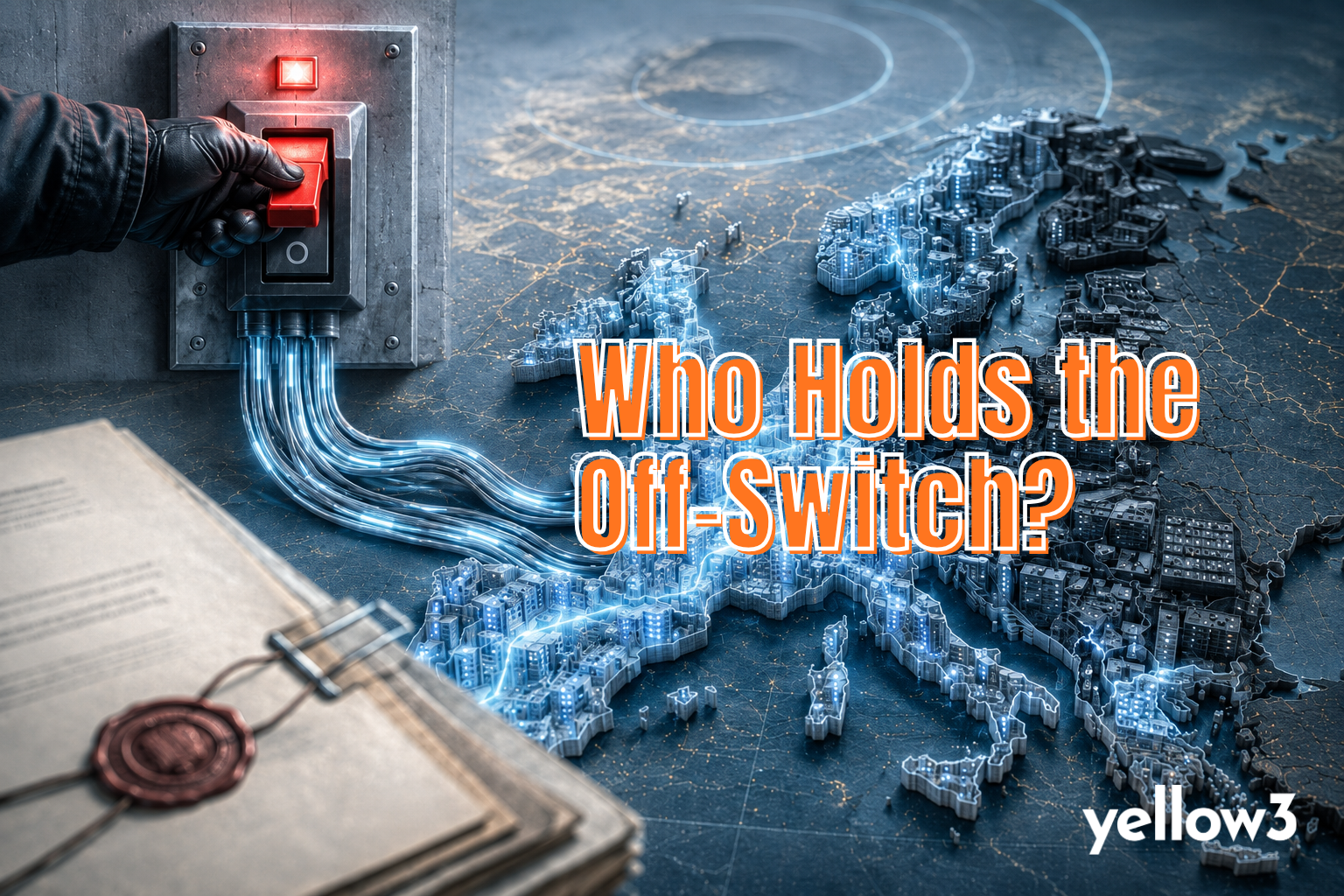
This week the US government issued an export control directive to Anthropic, citing national security, suspending all access to its most capable frontier model, in both its public Fable 5 and higher-tier Mythos 5 configurations, for any foreign national anywhere in the world. To comply, Anthropic had to disable it for every customer on the planet. By the company's own account, the trigger was a single narrow jailbreak that surfaced a handful of minor, already-known software vulnerabilities, the kind other publicly available models can find without any bypass at all.
Reasonable people will spend the next month arguing about whether the government was right. That argument is a distraction. The more important thing happened underneath it, and most of Europe missed it.
The principle is not the problem
Let us concede the hard part first, because the lazy version of this piece skips it.
A government must be able to stop a genuinely dangerous deployment. We do not let a private company sell untested pharmaceuticals on its own say-so, or ship nuclear material because its internal review went well. If a frontier model truly carried catastrophic risk, a democratic society delegating some pre-deployment authority to its government would not be paranoia. It would be ordinary. Anthropic itself has argued, repeatedly and in public, that the state should have exactly this power.
So the question was never "should government decide what models come out." Of course some authority has to exist. The real question is the boring one that decides everything: what does a legitimate process look like, and was this it?
By Anthropic's account, the answer is no. A directive with no stated specifics. A national-security rationale the company says it cannot see. A finding so narrow that, applied as a standard across the industry, it would halt every frontier deployment by every provider. Even the company most eager to give government this power says this particular use of it failed the basic tests of being transparent, fair, and grounded in fact.
That is a serious failure. But it is an American failure, about an American process, and Americans at least have standing to fix it. They can write to a representative. They can sue. They were, in some attenuated sense, governed by someone accountable to them.
Europe was simply switched off.
The afternoon Europe noticed the switch
Here is the part worth sitting with. Europe did not lose a model on Friday. Europe discovered, in the space of one afternoon, that it had never held the switch in the first place.
We have spent years on this. The AI Act runs to hundreds of pages. We built risk tiers, conformity assessments, transparency obligations, a whole architecture premised on the idea that artificial intelligence should be governed by visible, accountable, contestable process. It is the thing Europe is genuinely proud of and the thing the rest of the world rolls its eyes at.
And then the actual governance of the frontier infrastructure that European businesses run on every day happened anyway, by export-control letter, from a jurisdiction where no European has a vote, at a speed that made our entire regulatory apparatus look like a museum exhibit. The AI Act governs how a model may be used inside Europe. It has nothing to say about whether the model exists tomorrow. That decision was made somewhere else, by someone else, for reasons we are not allowed to know.
This is not a story about one company or one model. Anthropic happens to be the most safety-vocal lab in the industry, and it still ended up as the instrument here. The lesson generalises to every American frontier provider, which is to say, to nearly all of the frontier. The dependency is not abstract. It is the literal substrate under a growing share of European software, research, and public administration, and the off-switch for it sits in a building none of us can enter.
The trap in the obvious answer
The reflexive European response writes itself. Sovereign AI. Build our own. A continental champion, a European frontier model, an off-switch held in Brussels rather than Washington.
Be careful here, because this is where the thinking usually stops, and it should not.
Moving the switch from one capital to another is not sovereignty. It is a change of landlord. A European model that nobody uses because it lags two years behind is not independence, it is a subsidy with a flag on it. And an off-switch held by our own regulators, exercised with the same opacity, would be no better for the founder in Copenhagen than the one that just flipped. The problem this week was not that the wrong country held the switch. The problem was that the switch could be thrown at all, without process, without notice, without recourse, over the whole world.
Sovereignty, if the word is to mean anything for a European builder, is not a model. It is two unglamorous things. It is optionality: never building on a single frontier dependency you cannot replace inside a week, treating model access the way a serious operation treats any other supplier it does not own. And it is the insistence on legitimate process regardless of whose hand is on the switch, because the only thing worse than Washington being able to do this without rules is everyone being able to.
What to actually take from this
So no, this is not a moment for fear. Fear is the wrong response and, frankly, the cheap one. The doomers will tell you the machines are too dangerous to be allowed out. The libertarians will tell you the state should never have a say. Both are selling you a feeling instead of a question.
The question is better than the feeling. Who holds the off-switch for the infrastructure we are all quietly building our companies, our institutions, and our public services on top of? On Friday we learned the honest answer, and it is not us.
The builders who come out of this stronger will not be the ones who panicked, and not the ones who pretended it could not happen to them. They will be the ones who stopped treating frontier AI as a utility that will always be there, like water from a tap, and started treating it as what it actually is: a supplier in a foreign jurisdiction, governed by a process we cannot see, that can be ordered offline before our morning coffee.
Build accordingly. That is what sovereignty looks like now. Not a louder demand for our own machine. A quieter, more disciplined refusal to be switched off without a say.
Thomas Chr. Melskens is the founder of yellow3 lab.