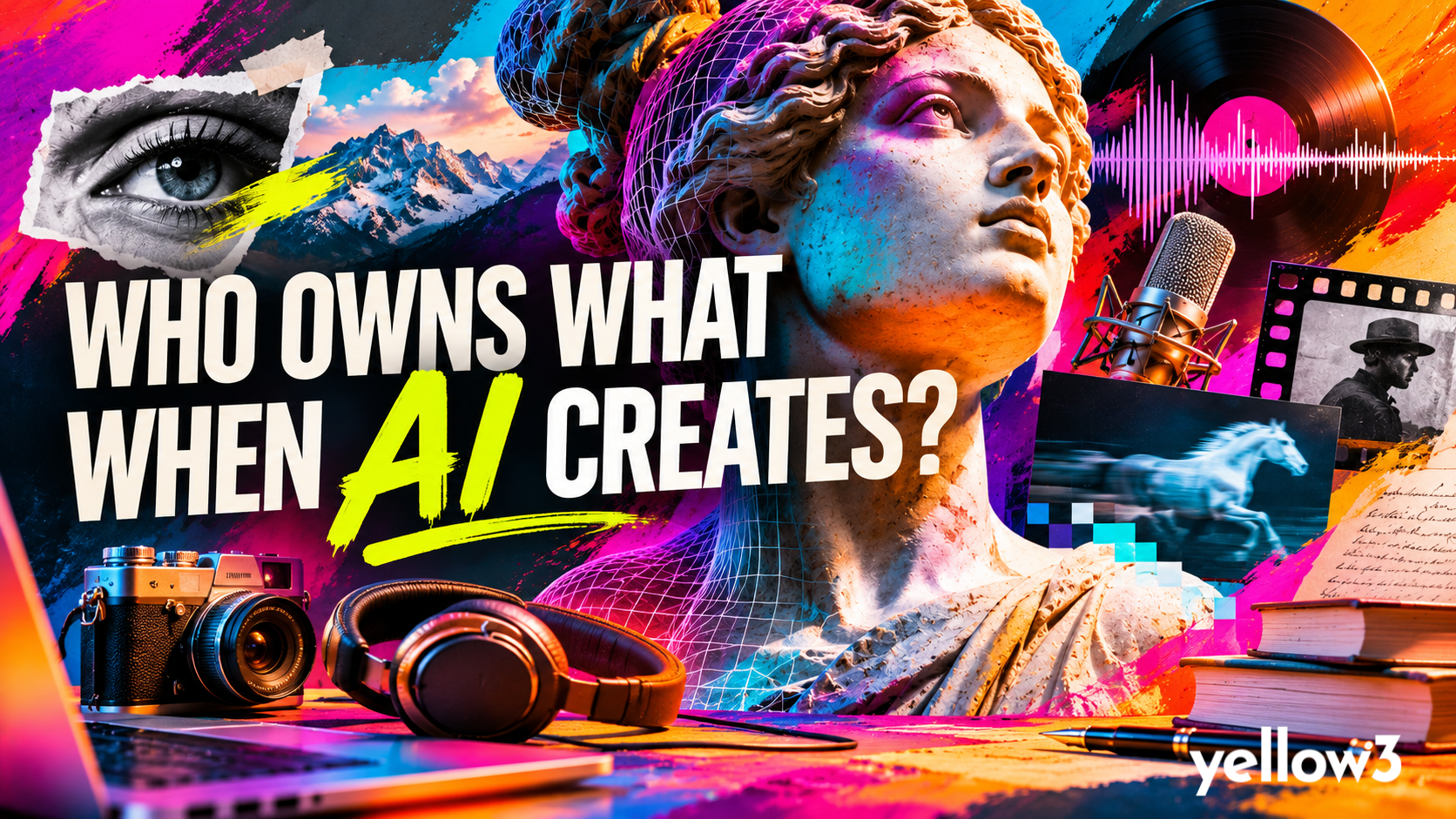
A photograph, a training dataset, a model, a prompt, an output and a remix can all be part of the same creative process. That does not mean they have the same owner, or even that they can be owned in the same way.
2 November 2026 · Thomas Christian Melskens · yellow3 Lab
The debate about artificial intelligence and creativity has become surprisingly emotional. Artists see machines capable of imitating styles that took them decades to develop. Musicians hear synthetic voices and AI-generated songs. Designers can produce dozens of concepts in minutes. Writers, photographers and filmmakers are watching tools learn from a vast body of human culture and then create something new from it.
Behind much of that debate sits a deceptively simple question: who owns what AI creates?
It sounds as though there should be one answer. There isn't.
An AI-generated work can involve an original creator, material used to train a model, the company that built the model, the person directing the AI, the finished output and sometimes another person who later transforms that output again. Each stage can involve different rights, different owners and different legal rules.
That distinction matters, because much of the public argument about AI treats “ownership” as if it were one thing. It is not.
Start with something familiar
Imagine a photographer takes a photograph. That photograph may be protected by copyright. If it is later used by an AI system, the photographer does not suddenly lose those rights simply because a new technology entered the picture.
The same principle applies to music, books, illustrations, films, software and other protected works. AI does not create a legal vacuum around material that already exists.
The difficult questions begin when that original work becomes part of a much longer chain. Perhaps it is included among millions of images used to train a model. Someone then uses that model to create a new image, spends an hour refining the result and edits it manually afterwards. Later, another person takes that finished image and transforms it again.
At that point there is no longer one creative act. There is a sequence of them, and each part of the sequence can raise a different ownership question.
Was the material allowed to be used for training?
Generative AI systems have been trained using enormous quantities of text, images, music, code and other material. Some of it is protected by copyright, which has made training one of the central legal disputes of the AI era.
But even here, “the AI was trained on copyrighted material” is not a complete legal conclusion.
EU copyright law allows certain forms of text and data mining. For commercial text and data mining, rightsholders can reserve their rights. The EU AI Act adds further obligations for providers of general-purpose AI models, including policies for complying with copyright law and requirements to publish sufficiently detailed information about training content.
So the relevant questions become more specific. Was the material lawfully accessible? Had the rightsholder reserved the relevant rights? Was the material licensed? Where did the relevant copying take place? Which country's law applies?
Those details are less satisfying than declaring that all AI training is either legal or illegal. They are also much closer to how copyright law actually works.
Does the model itself contain a copy?
The next question is even more interesting.
When an AI model learns from a protected work, does it merely learn relationships and patterns, or can the resulting model itself contain a legally relevant copy of the original material?
European courts are already beginning to confront that distinction.
In November 2025, the High Court in England ruled in Getty Images' case against Stability AI, the company behind Stable Diffusion. One of the remaining questions was whether Stable Diffusion itself could be treated as an infringing copy of Getty's works imported into the United Kingdom.
The court rejected that argument in the case before it. An important nuance is that Getty was not, at that stage, arguing that the model itself stored copies of its protected photographs.
Only days later, the Munich Regional Court considered a different situation in a case brought by German music rights organisation GEMA against OpenAI. That dispute concerned nine protected German song lyrics. The court found that lyrics had been memorised in OpenAI's models and could be reproduced from them. It treated that memorisation as copyright reproduction and also found infringement where protected lyrics appeared in outputs.
The cases are therefore not simple opposites. They dealt with materially different factual situations.
But together they expose an issue that could become fundamental to AI copyright law: when a model has learned a work, has it learned from it, or does it sometimes contain it?
Europe does not yet have a settled answer.
Europe is still deciding the rules
That uncertainty is now reaching the Court of Justice of the European Union.
Like Company v Google, C-250/25, is the first CJEU reference specifically asking how EU copyright rules apply to generative AI. The dispute concerns press material allegedly reproduced by Google's Gemini chatbot, and the questions before the Court touch directly on reproduction, AI training, chatbot output and text and data mining.
The case remains pending.
That is important beyond the lawyers involved. Companies, creators and AI developers are making commercial decisions today under rules that Europe's highest court is still being asked to define.
This is not a theoretical argument about technology we may use in the future. The technology is already widely available. The legal framework is catching up while people are using it.
What did the human actually create?
There is another side to the ownership debate that receives less attention.
Suppose someone asks an AI system to “create a logo for a bakery” and accepts the first result. Compare that with a designer who develops the concept, supplies reference material, writes detailed instructions, rejects dozens of outputs, changes the composition, combines elements and then finishes the work manually.
Calling both results “AI-generated” tells us very little about what actually happened.
Under EU copyright law, originality is connected to the author's own intellectual creation and the expression of free and creative choices. The important issue is therefore not simply whether AI was used, but how much creative control remained with the human.
A Munich court considered that question directly in February 2026 in a dispute concerning three AI-generated logos. The person behind them had used detailed prompts and made subsequent changes, but the court concluded that sufficient human creative influence over the resulting works had not been demonstrated to establish copyright protection.
That does not mean AI-assisted work cannot be protected by copyright. It means that using an AI system and authoring the resulting work are not automatically the same thing.
As AI becomes embedded inside photography, Photoshop, video editing, music production, writing and software development, this distinction will become increasingly important. In a few years, describing something simply as “AI-generated” may be about as informative as saying it was “made on a computer”.
The answer also changes across borders
Even the human-authorship question does not have exactly the same answer everywhere.
EU copyright law places human creative choices at the centre of originality. The United Kingdom, however, has a specific provision covering certain computer-generated works. Under Section 9(3) of the Copyright, Designs and Patents Act, the author of such a work is deemed to be the person who undertook the arrangements necessary for its creation.
How that provision should apply to modern generative AI remains open to interpretation, but its existence demonstrates an important point: there is no single global rule for AI ownership.
The answer can depend on where you are.
The platform's terms are another layer
Then there is the agreement between the user and the AI provider.
OpenAI's current European terms, for example, state that as between the user and OpenAI, and to the extent permitted by law, the user owns the output and OpenAI assigns any rights it may have in that output to the user. The terms also make clear that outputs may not be unique and that other users can receive similar material.
That distinction matters because a contractual promise and statutory copyright are not the same thing.
An AI provider can say that it does not claim ownership of your output. It can assign whatever rights it holds to you. What it cannot necessarily do is create an exclusive copyright against the rest of the world if copyright law says that the work does not qualify for one.
For businesses, that makes the contract worth reading for another reason as well. Some AI providers offer intellectual property indemnities under certain commercial arrangements. Others exclude important categories of risk.
So a company evaluating an AI service should not only ask whether it “owns the output”. It should also ask what happens if somebody else says it does not.
AI did not invent remixing
At this point, the discussion starts to look less revolutionary than it first appeared.
Culture has always built on what came before. Musicians sample other musicians. Filmmakers reference earlier films. Artists make collages. Designers work within movements and traditions. Writers reinterpret stories that have existed for generations.
AI did not invent derivative creativity. It dramatically increased its speed and scale.
This year, the Court of Justice of the European Union ruled on a copyright dispute that began long before generative AI entered everyday life. Pelham, C-590/23, concerned a roughly two-second sample from Kraftwerk's Metall auf Metall.
In April 2026, the Court clarified how the EU copyright exception for “pastiche” can apply. The judgment recognised circumstances in which a new creation may use protected elements from an earlier work while remaining noticeably different and engaging with it through an identifiable artistic or creative dialogue.
The ruling did not create a general right to copy someone else's work. But it illustrates a problem that existed long before ChatGPT, Midjourney or Suno: when does building on an earlier work become a new creative act?
AI has not invented that line. It has made it much easier for millions of people to test it.
Style may be the hardest part emotionally
Copyright law becomes especially difficult to explain when the issue is not a particular work, but a recognisable style.
We recognise artists through more than individual pieces. A photographer may have a distinctive visual language. A musician can have an unmistakable sound. A designer may develop an aesthetic that people associate immediately with their name.
When an AI system can imitate that style in seconds, it can understandably feel as though something has been taken.
Legally, however, similarity of style and infringement of copyright are not necessarily the same thing. Copyright traditionally protects particular expressions rather than an abstract style itself.
That does not mean anything goes. An output can still reproduce protected parts of existing works. Trademark law, unfair competition, contractual rights and other rules may apply.
But precision matters. Saying “this looks like that artist” is not automatically the same as saying “this infringes that artist's copyright”.
The moral argument and the legal argument can overlap without being identical.
When AI copies a person, the question changes again
Now replace the artwork with a human being.
A realistic imitation of someone's face, voice or movements raises a different category of concern. The issue is no longer simply whether a protected creative work was copied. It becomes a question of whether somebody should be entitled to create and distribute a convincing digital imitation of another person.
Denmark is currently confronting that question directly.
Bill L 49, introduced in October 2026, proposes changes to the Danish Copyright Act that would protect people against realistic digitally generated imitations of personal characteristics, including appearance and voice, being made available without consent. It would also introduce protection relating to digital imitations of performers, while maintaining exceptions and safeguards around areas such as satire, parody and criticism.
The proposal illustrates how quickly the meaning of “ownership” starts to break down when AI becomes involved.
You do not simply own your face in the same way a photographer owns a photograph. Yet society may still decide that another person should not be free to create and distribute a realistic synthetic version of you.
Sometimes copyright is not the right question at all.
And then someone remixes your AI creation
There is a useful thought experiment that exposes how complicated our attitudes towards AI creativity can become.
Imagine you spend hours creating something with AI. You develop the idea, control the process, reject dozens of attempts, make detailed changes and finally publish something you consider your work.
The next day, somebody takes it, feeds it into another AI system, transforms it and publishes their own version.
Suddenly the ownership question feels different.
The reason is simple. Once your output becomes somebody else's input, the whole chain begins again.
What elements came from your work? What did the second person contribute? Was anything protected? Was the new result sufficiently different? Was the transformation permitted?
The person using AI today can become the creator asking for protection tomorrow.
That is one reason the debate deserves more nuance than “AI is stealing” on one side and “everything is fair use” on the other.
Neither position gets us very far.
Six different questions hiding inside one
A useful way to think about AI ownership is therefore as a stack of separate questions.
First, there is the original material. Who owns the photograph, song, article, video, software or other work that existed before the AI became involved?
Then there is training. Was that material lawfully used to develop the system?
Third comes the model itself. Has it merely learned statistical relationships, or has it memorised protected expression in a legally significant way?
Fourth is the human contribution. What did the person using the system actually decide, create, control and edit?
Fifth is the output. Does the finished result qualify for copyright protection and, if so, who owns it?
Finally there is the contract. What have the user and the AI provider actually agreed about rights, commercial use and liability?
If the resulting work is then remixed, the same questions begin again.
Seen this way, “who owns the AI creation?” is not one question at all.
It is six questions compressed into a sentence.
What this means outside the courtroom
Most people using AI do not need to become copyright experts.
But the basic distinctions matter increasingly in ordinary life and business.
If you are creating something commercially valuable with AI, keep a record of your own creative process. Know what material you supplied to the system and what you changed yourself. Understand the terms of the service you are using, particularly if the output will become a brand asset, a product, a campaign or another important piece of intellectual property.
Businesses should also start treating questions about training data, licensing, ownership and indemnities as part of AI procurement rather than leaving them entirely to technical teams.
And perhaps most importantly, do not assume that something is legally safe simply because a machine generated it. AI can produce new material, but it can also reproduce protected material, trademarks, confidential information and increasingly convincing representations of real people.
The machine does not remove the rights that existed before it arrived.
Perhaps we are asking the wrong question
Much of the debate about AI and creativity eventually becomes philosophical. Is AI really creative? Is it merely copying? Can a machine be an artist?
Those are interesting questions, but they may not be the most useful ones.
Copyright law was not created to decide whether a machine has imagination. It exists because humans create, copy, transform, licence, sell and argue about creative work.
AI changes the scale of that activity dramatically. It allows one person to create and transform material at a speed that was previously impossible.
But it does not remove the humans from the chain.
A photograph can contribute to a model. A model can produce an image. A person can turn that image into a finished work. Another person can remix it. Each step can create new rights and new questions without automatically erasing what came before.
So the next time someone asks:
“Who owns something made by AI?”
The most accurate answer may be another question:
Which part do you mean?
This article provides general information and is not legal advice.